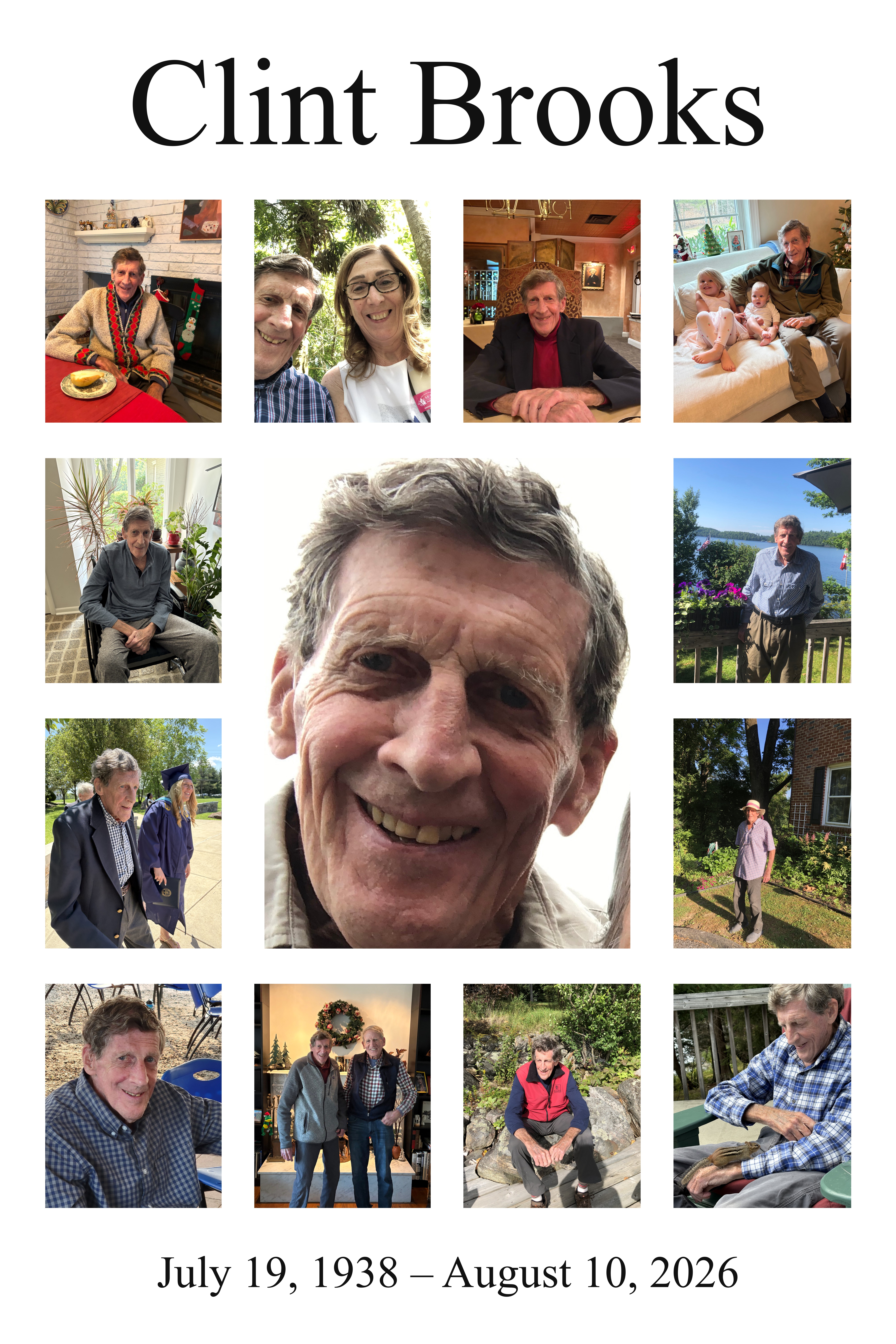
Clinton C. “Clint” Brooks
A life of service, wisdom, recovery, and love
Clinton C. “Clint” Brooks died on August 10, 2026 at the age of 88 at home in Wilmington, DE. He leaves a remarkable legacy of service—to his country, his family, the recovery community, the natural world, and the many people whose lives were enriched by his wisdom, constancy, and gentle kindness. Clint lived across eight distinct decades, two centuries, and two millennia. He was born into an analog world and departed from a digital one that he had helped bring into being. Through all that change, the qualities at his core remained constant: intellectual curiosity, moral courage, humility, discipline, compassion, and a gentle kindness present in every part of his life.
His was a life of consequential accomplishments but also of daily grace. He served his country without seeking recognition, helped others without keeping count, protected the places that renewed him, and worked—quietly and persistently—to make the world a better place. Those who knew him will miss his steady presence, his thoughtful counsel, his warmth, and the unmistakable sense that, in his company, they had been truly seen and heard.
Clint was born and raised in Sewickley, PA. He graduated cum laude from The Hotchkiss School in Lakeville, CT, in 1956 and earned a Bachelor of Science in physics from Yale University in 1960. A member of the Navy ROTC program at Yale, he remained there to pursue doctoral study and research in radio astronomy until he was called to active duty in 1965.
At the height of the Cold War, Clint was assigned by the Navy to the National Security Agency (NSA), where his background in astronomy and physics was applied to intelligence efforts focused on the Soviet space and missile programs. He had the rare vantage point of understanding both the American Apollo program and the Soviet effort during the race to land a person on the moon. For this work, he received the Joint Service Commendation Medal.
After completing his Ph.D. at Yale in 1968, Clint returned to the NSA as a civilian and devoted the next three decades to public service. Over the course of an exceptional career, he led satellite constellation planning and design and the development, deployment, and operation of advanced information collection systems. He also envisioned and brought online a state-of-the-art microelectronics facility capable of producing classified cryptography chips (Clipper Chips) for national security needs.
Later, as Assistant Deputy Director for Information Systems Security, Clint recognized early the transformational power—and the risks—of the emerging Internet. He helped shape a national cryptologic strategy intended to provide strong information protection for citizens and critical systems while preserving lawful capabilities needed by law enforcement and national security authorities. This work, including the policy debate about the Clipper Chip, was later chronicled by Steven Levy in Crypto. Clint subsequently became the NSA’s first Corporate Knowledge Strategist, helping the Agency adapt from its Cold War orientation to the threats of a new era. He retired in May 2001 after 36 years of service.
Following the terrorist attacks of September 11, 2001, Clint answered his country’s call once more. He returned to the NSA to help develop strategy in support of the nation’s emerging homeland security mission, serving until May 2003.
Clint’s many professional honors reflected both the importance of his work and the integrity with which he performed it. They included the Meritorious Executive Presidential Rank Award from President Ronald Reagan; the Distinguished Executive Presidential Rank Award from President Bill Clinton; the National Intelligence Distinguished Service Medal; plus other notable medals.
Yet Clint’s patriotism was larger than professional accomplishment. He loved his country in the finest sense of the word: not as an abstraction, but as a responsibility. He believed that knowledge should be used in service of others, that institutions should be worthy of the people who depend upon them, and that citizenship required both courage and humility. Whether working on matters of national consequence or helping a neighbor, he was guided by the same quiet purpose—to leave the world safer, wiser, kinder, and better than he found it.
Central to Clint’s life was his sobriety, which began in 1972 and continued, one day at a time, for the rest of his life. For more than five decades, he was deeply committed to the recovery community. From the earliest years of his own recovery, he offered his presence, experience, candor, and hard-won wisdom to others. He understood that recovery was not simply abstinence, but a way of living rooted in honesty, accountability, gratitude, service, and love. His steadfast example gave hope and direction to people at every stage of the journey. He never treated this service as an achievement; it was simply part of who he was—showing up, listening carefully, speaking truth gently, and helping another person find the next right step.
In retirement, Clint remained an energetic teacher and lifelong learner. He was the DeRoy Visiting Honors Professor at the University of Michigan in 2002, where he led a seminar titled “Ramifications of Our Networked World.” He gave astronomy presentations for continuing-learning programs, schools, and community organizations, sharing the wonder of the universe with audiences of all ages. He was instrumental in establishing the Peer Learning Partnership, a lifelong-learning program at Anne Arundel Community College. He was also actively involved with the Touchstones Discussion Project and at one time helped conduct one of its programs at the Maryland House of Correction, reflecting his enduring belief in the dignity, capacity, and potential of every person.
Clint found spiritual renewal in nature. He climbed mountains, ran marathons—including the Boston Marathon in 2 hours and 40 minutes at age 40—canoed, kayaked, hiked, and trekked. Those who knew him well often said he was happiest outdoors, moving through the natural world with curiosity, discipline, and reverence.
For many years, Clint and his family spent summer vacations on Ahmic Lake in Ontario, Canada. After retiring from the NSA, he spent roughly half of each year at the lake. As elsewhere in his life, he became an active steward of the community he loved. He served as a director of the Ahmic Lake Golf Club, an officer of the Ahmic Lake Cottagers’ Association, and a member of several municipal mayoral committees. He also led the establishment of the Magnetawan River Watershed Association to protect and preserve the region’s natural environment for future generations.
Clint married Anne Bradford Peters, also of Sewickley PA, in June 1961. They had two sons and divorced in 2002. In 2012, Clint and Catherine Marino began a life partnership grounded in a conscious commitment to ever-deepening love—for one another and for their expanding families—and to living contemplative lives.
He is survived by his life partner, Catherine Marino; his sons, Christopher C. Brooks and Clinton C. Brooks, Jr.; six grandchildren; two great-granddaughters; his brother, Jay Brooks, of Sewickley, PA, and Catherine’s children and grandchildren whom he gladly mentored.
In lieu of flowers, memorial donations may be made to the Touchstones Discussion Project, 142 Log Canoe Circle, Stevensville, MD 21666 (touchstones.org).
Family and friends are invited to a celebration of life at Gulph Mills Golf Club in King of Prussia, Pa on September 27 at 1pm.